ホームエレベーターと別荘エレベーターの専門メーカー|SGS, SGC, SGRZ, CNCA, CNAS & ISO 9001Certified

JDRK Product Team | Jiade (Shandong) Elevator Co., Ltd. | Published September 2026
A トラクションエレベーター moves the cabin using a motor-driven sheave and a suspension belt or rope, rather than hydraulic fluid pressure. In a home installation, that usually means a machine-room-less unit with a permanent-magnet motor mounted inside the shaft rather than a separate equipment room — a meaningfully different setup than the commercial version of the same term.
Type “traction elevator” into a search bar and most of what comes back is written for a building engineer sizing equipment for an eight-story office block — counterweight ratios, elevator banking, dispatch algorithms. None of that maps onto a three-story house. This guide covers the same underlying mechanism, translated for what actually changes when a traction elevator goes into a villa: shaft footprint, household power compatibility, and what a homeowner needs to check before assuming one will fit.
The word “traction” refers to how the cabin gets its lifting force: friction between the suspension belt (or rope) and a motor-driven sheave at the top of the shaft, rather than a hydraulic ram pushing from below. That single distinction is why traction elevators can travel faster and reach greater heights than hydraulic units in commercial settings — though for a two- or three-story home, both technologies cover the vertical distance without difficulty, so speed isn’t usually the deciding factor for a residential buyer.
JDRK’s Traction Type Villa Elevator runs on a permanent-magnet synchronous motor connected to a polyurethane traction belt, controlled through a VVVF (variable voltage variable frequency) drive. The belt replaces the steel wire rope used in older traction designs; JDRK states it’s lubrication-free and rated for roughly 2 to 3 times the service life of a conventional wire-rope setup.
Older トラクション・エレベーター used a worm-gear reduction box between an induction motor and the sheave — a “geared” system that needs periodic gearbox lubrication and typically requires a dedicated machine room to house the extra hardware. JDRK’s permanent-magnet motor connects straight to the sheave with no gearbox, which puts it in the gearless category. That’s not a marketing distinction; ASME’s elevator and lift equipment standards cover both configurations without mandating one over the other, and the practical difference for a homeowner comes down to machine-room space and long-term maintenance rather than safety.
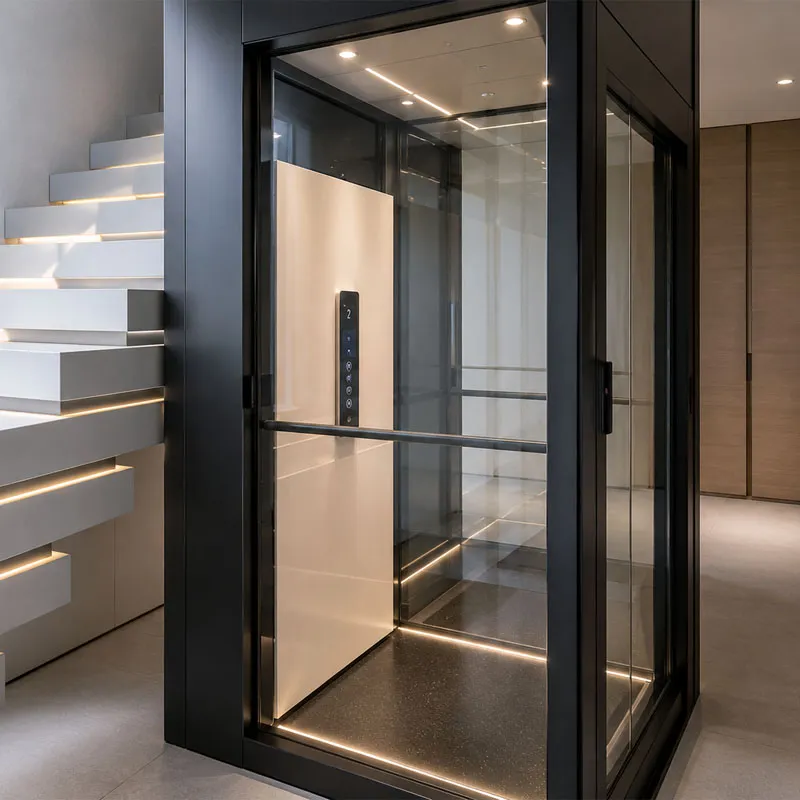
Because the motor sits inside the shaft — mounted in a backpack or gantry configuration rather than in a separate room — there’s no dedicated equipment room to plan for above or beside the shaft. That matters more in a retrofit than in new construction: adding a machine room to an existing house usually means sacrificing attic space or building an external structure, while a machine-room-less unit fits inside the same footprint as the shaft itself.
Compared to the way traction elevators are typically framed in commercial buildings — where a machine room is often assumed as standard — a villa-scale machine-room-less traction elevator is closer in installation logic to the hydraulic line: shaft-only, no separate room, subject mainly to shaft dimension and pit depth constraints rather than equipment-room availability.
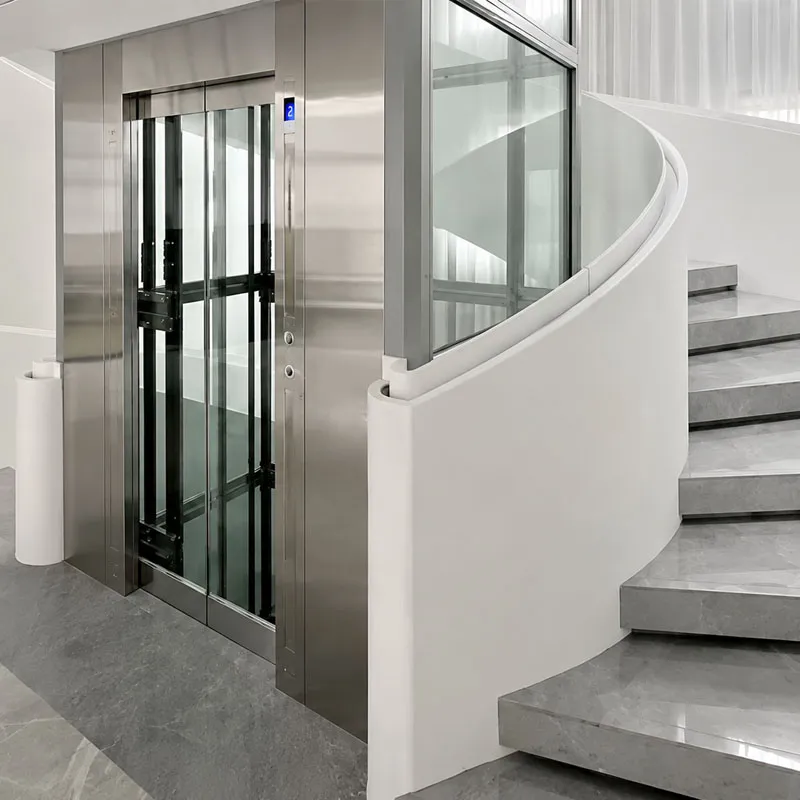
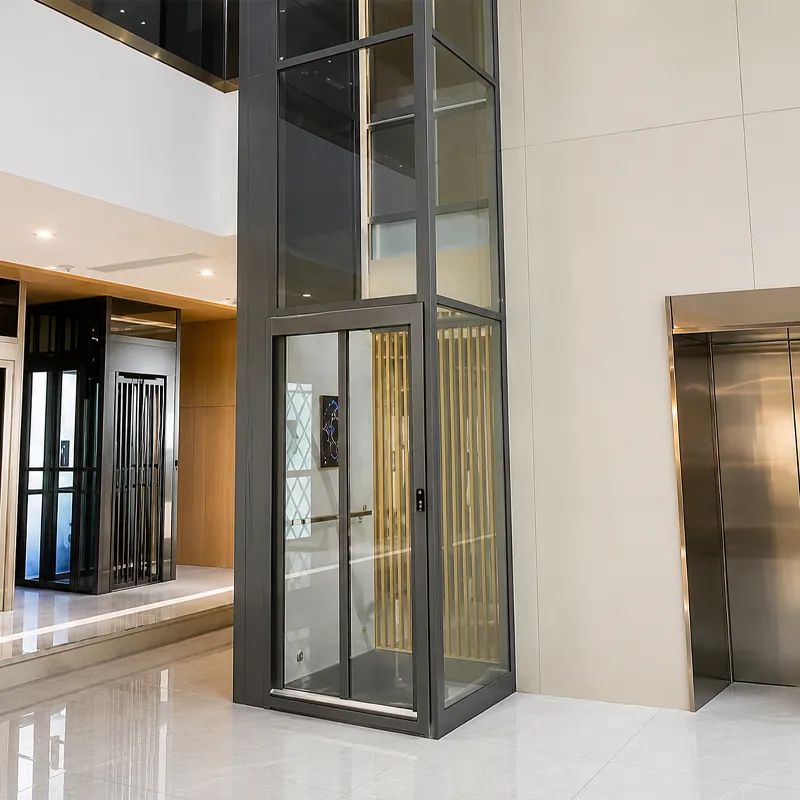
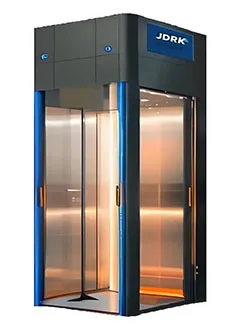
JDRK’s traction line ships with panoramic round/curved glass and minimalist finish options as standard cabin styles, with additional finish variants available. The company also references an earlier development of a 180° curved glass cabin with smart dimming glass aimed at villa-scale shaft constraints — a company-stated capability rather than an independently audited one. Trim, door finish, and control-panel customization sit on top of these base styles as a separate accessory layer rather than a structural choice.
The other core question homeowners run into is whether traction or hydraulic makes more sense for a specific house. Traction uses a motor-and-belt system with no fluid reservoir; hydraulic uses pressure-driven ascent and gravity-driven descent through a power unit, with no counterweight and — per JDRK’s published figures — up to roughly 70% shaft space utilization as a result. Neither is a universal answer; the deciding factors are usually shaft depth availability, top-floor clearance, and whether the house already has a pit dug or needs one.
The documentation for JDRK’s traction line centers on the built-in UPS with ARD auto-leveling during power outages as the specifically published safety feature — the cabin doesn’t stay stalled between floors if power cuts out mid-ride. Beyond that specific feature, a full itemized safety-component list (governor type, door interlock specifics, and similar detail) isn’t published for the traction line in the current documentation, so a project requiring that level of specification detail should confirm directly with JDRK rather than relying on generic industry assumptions.
This is a genuine gap worth naming directly: JDRK’s documentation doesn’t publish a specific minimum shaft footprint for the Traction Type Villa Elevator the way it does for the hydraulic line (roughly 1,100 × 1,100 mm) or the platform-lift line (roughly 900 × 900 mm). If shaft sizing is the deciding factor for your project, that number needs to come from a direct quote request rather than being assumed from the other product lines’ figures — the drive systems aren’t interchangeable in terms of space requirements.
JDRK doesn’t publish pricing for the 牽引式ヴィラ・エレベーター anywhere on its site — every configuration routes to a quote request rather than a price list. What actually moves the number for a specific project: shaft dimensions relative to what the installation needs, cabin finish tier (panoramic glass costs more than a minimalist panel finish), and whether the project is new construction or a retrofit into an existing shaft, which usually adds labor cost regardless of drive type. A same-day WhatsApp message with rough shaft dimensions is faster than waiting on a generic price range that may not apply to the actual project.
This assumption holds for older geared systems but not for JDRK’s gearless, machine-room-less configuration. The confusion usually comes from search results that default to commercial elevator context, where a machine room is still common. For a villa-scale installation specifically, the absence of a machine room is closer to the norm than the exception on JDRK’s current product line.
A: Traction elevators generally travel faster in commercial applications, but for a two- to three-story home, both technologies cover the distance in a comparable amount of time — speed isn’t usually the deciding factor at residential scale.
A: JDRK’s documentation states the traction line uses a machine-room-less structure; a low-pit or shallow-pit configuration is standard practice for villa-scale traction installations, but the exact minimum pit depth for this specific line isn’t published — confirm the number directly for your shaft.
A: The built-in UPS keeps the ARD functional, auto-leveling the cabin to the nearest floor rather than leaving passengers stopped mid-shaft — this is the specific safety feature JDRK documents for the traction line.
A: Related but not identical — gearless describes the motor-to-sheave connection (no gearbox), while machine-room-less describes where the drive components are mounted (inside the shaft rather than a separate room). JDRK’s unit is both, but the two terms answer different questions.
 Japanese
 English
 French
 German
 Russian
 Spanish
 Portuguese
 Dutch
 Arabic
 Czech
 Korean