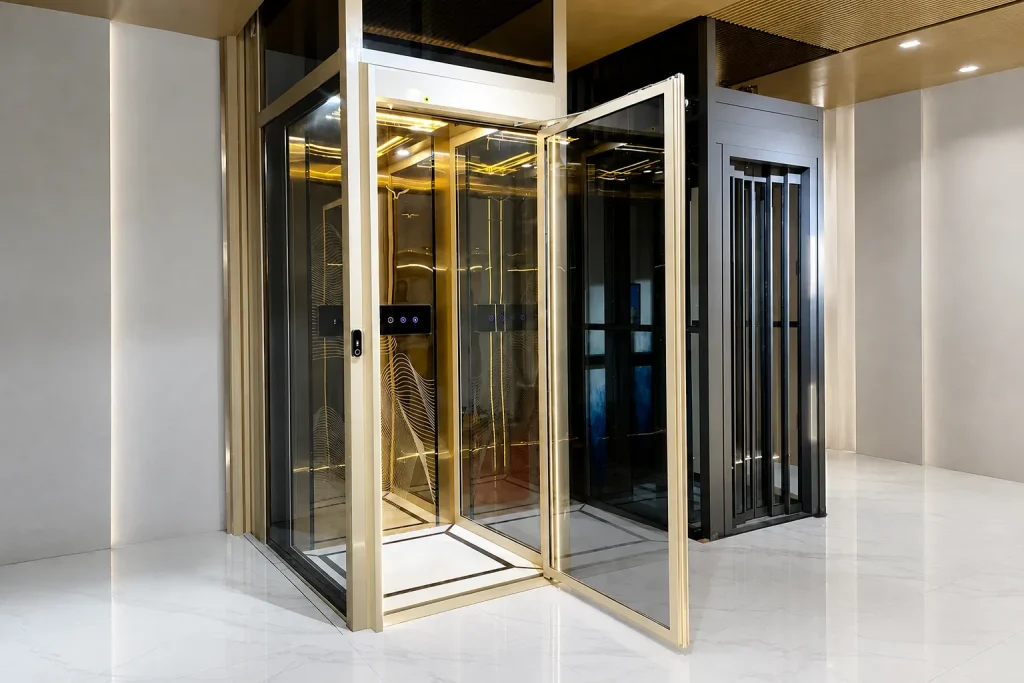
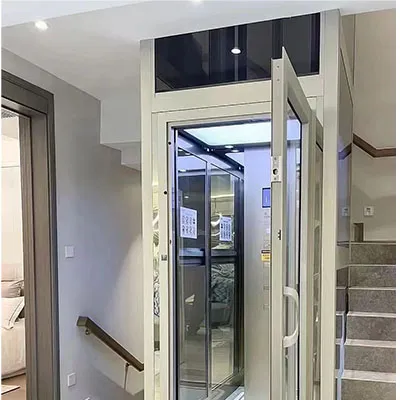
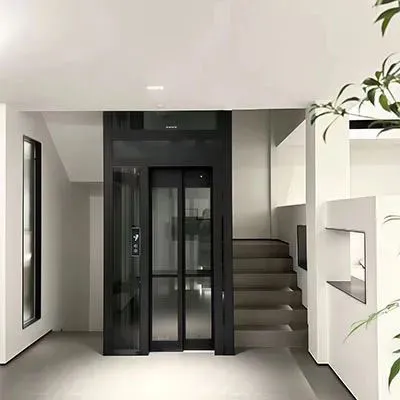
Un ascenseur résidentiel à commande hydraulique pour villa utilise des cylindres, des pompes et des vannes de contrôle haut de gamme. Sa valve proportionnelle de haute précision permet de réguler la vitesse en douceur et en continu.
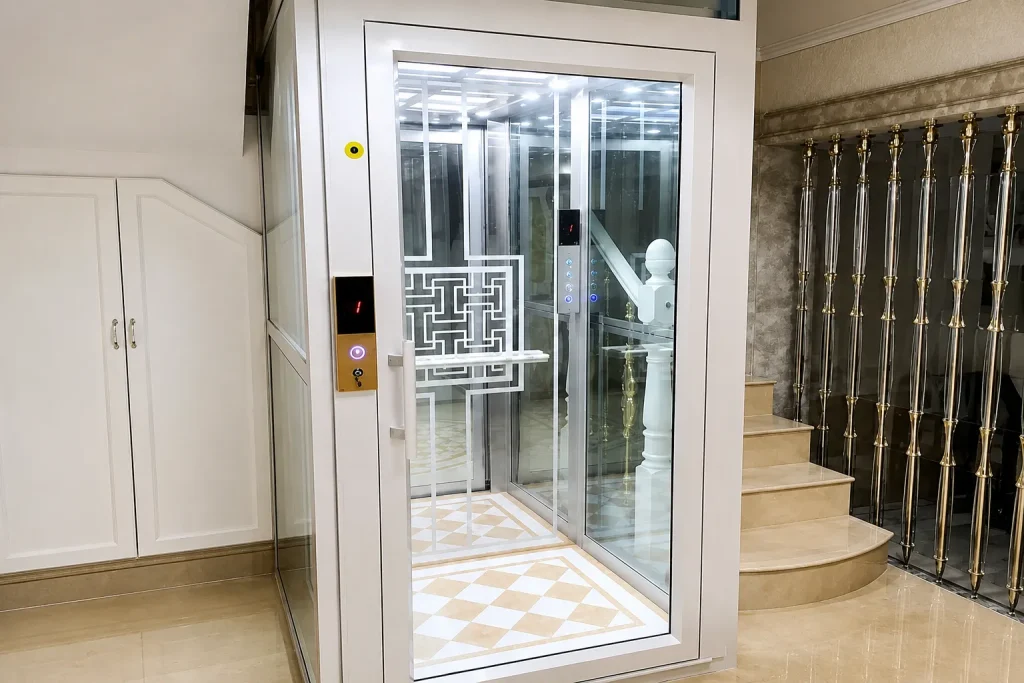
Ascenseur domestique à traction : Pas de salle des machines, ce qui permet de réduire les coûts. Utilise un contrepoids/un portique, s'adapte aux types de portes de la maison. Entraînement VVVF pour un déplacement en douceur
Hydraulic Elevator vs Traction Elevator: Which Type of Elevator Is Better for Your Project?
Choosing the wrong elevator can increase construction costs, reduce usable space, and create long-term maintenance problems. The risk becomes greater when buyers compare systems only by price. Understanding the differences between a hydraulic elevator and a traction elevator helps developers, contractors, and distributors choose a safer and more practical solution.
A hydraulic elevator uses a pump, hydraulic fluid, cylinder, and piston to raise the elevator car. A traction elevator uses a motor, sheave, and steel ropes or belts. Hydraulic elevators are commonly selected for low-rise homes with limited overhead, while traction elevators are generally better suited to taller buildings, higher travel speeds, and more frequent use.
What Is a Hydraulic Elevator?
A ascenseur hydraulique is a type of elevator that moves the elevator car through fluid pressure. Its main components normally include an electric motor, hydraulic pump, oil reservoir, control valve, cylinder, piston, elevator car, guide rails, and safety system.
When the elevator travels upward, the pump transfers hydraulic fluid from the reservoir into the cylinder. The increasing pressure pushes the hydraulic piston upward, raising the elevator cab. When the elevator descends, the hydraulic valve releases the fluid back into the reservoir, allowing the car to move downward under controlled gravity.
Compared with some traditional traction systems, a hydraulic elevator can provide a relatively simple drive arrangement. It normally does not require a counterweight. This characteristic can improve space utilization inside the elevator shaft and provide more flexibility when planning a home elevator for an existing building.
At Jiade (Shandong) Elevator Co., Ltd., we focus on home and villa elevator solutions for private residences, duplex homes, and low-rise buildings. Our goal is not simply to supply an elevator unit. We work with overseas distributors, contractors, architects, and developers to match the elevator system with the building structure and interior design.
Comment fonctionne un ascenseur hydraulique ?
To understand how a hydraulic elevator works, consider its operating cycle.
During upward travel, an electric motor drives the pump. The pump sends hydraulic oil from the reservoir into the hydraulic cylinder. As pressure builds, the piston extends and lifts the elevator car. The system controls acceleration, operating speed, leveling, and stopping to provide stable travel.
During downward travel, the motor usually does not need to drive the car in the same way. Instead, the control valve opens and allows hydraulic fluid to return gradually to the reservoir. The car’s weight produces the downward movement, while the hydraulic valve controls the speed.
The main process can be summarized as follows:
The passenger selects a floor.
The control system sends a travel command.
The pump delivers hydraulic fluid to the cylinder.
The hydraulic piston raises the elevator car.
The control system slows and levels the car.
During descent, the valve returns the fluid to the reservoir.
Safety devices monitor the elevator throughout the journey.
The quality of the pump, cylinder, valve, seals, guide system, and controller directly affects ride comfort and operational stability. Buyers should therefore evaluate the complete hydraulic system rather than comparing only the appearance or initial price.
What Is a Traction Elevator?
A traction elevator uses an electric motor, drive sheave, suspension system, and usually a counterweight. The elevator car and counterweight are connected by steel ropes or belts. As the motor rotates the sheave, the car moves upward or downward along the guide rails.
Traction systems are generally divided into geared and gearless traction designs. Geared systems use a gearbox between the motor and drive sheave. Gearless traction elevators connect the motor more directly to the sheave, helping provide smooth and efficient operation.
Modern villa elevators often use permanent-magnet synchronous gearless traction machines. This arrangement can provide quiet operation, compact installation, and precise floor leveling.
A traction elevator is normally more suitable for:
Buildings with greater travel height
Projects requiring higher operating speeds
Elevators that run more frequently
Multi-floor residential or commercial buildings
Projects where energy use during repeated travel is important
However, the final choice depends on the building structure, shaft dimensions, overhead space, pit depth, number of stops, rated load, and local elevator regulations.
Hydraulic Elevator vs Traction Elevator: What Is the Difference?
The primary difference between traction and hydraulic systems is how they create vertical movement. A hydraulic elevator uses fluid pressure and a piston. A traction elevator relies on friction between the drive sheave and steel ropes or belts.
Comparison Factor
Élévateur hydraulique
Élévateur à traction
Drive principle
Hydraulic pressure moves a piston
Motor turns a sheave and suspension system
Main components
Pump, reservoir, valve, cylinder and piston
Motor, sheave, ropes or belts and counterweight
Common application
Homes, villas and low-rise buildings
Low-, mid- and high-rise buildings
Counterweight
Usually not required
Usually required
Travel speed
Generally lower
Generally higher
Travel height
Better suited to limited travel
Suitable for greater travel heights
Overhead requirement
Can support low-overhead solutions
Depends on drive and layout
Pit requirement
Zero-pit, shallow-pit or standard options may be possible
Normally requires a designed elevator pit
Ride frequency
Suitable for moderate residential use
Better for frequent operation
Maintenance focus
Oil, seals, valve, pump and cylinder
Motor, brake, ropes or belts and sheave
Design flexibility
Well suited to constrained residential layouts
Multiple frame and shaft configurations
Typical buyer concern
Leakage, height and equipment location
Space, suspension wear and drive arrangement
Neither elevator type is universally better. The better choice is the system that fits the building, usage pattern, local code, and project budget.
What Are the Main Types of Hydraulic Elevators?
The common types of hydraulic elevators differ mainly in cylinder arrangement, lifting method, and equipment layout.
Holed Hydraulic Elevator
A holed hydraulic elevator uses a cylinder that extends below the elevator pit into a drilled underground hole. The piston rises from this cylinder and moves the elevator car.
This structure can provide direct lifting, but it requires suitable underground conditions. Drilling depth, groundwater, corrosion protection, and underground utilities must be evaluated before installation. For many residential renovation projects, the required underground work may be difficult or expensive.
Holeless Hydraulic Elevator
A holeless hydraulic elevator places one or more cylinders beside the elevator car instead of inside a deep underground bore. This configuration reduces the need for deep excavation and can be more practical where underground drilling is restricted.
“Holeless” does not mean that the elevator has no shaft or pit. It means that the hydraulic cylinder does not require a deep drilled hole below the shaft. Pitless, shaftless, holeless, and machine room-less describe different design characteristics and should not be used as interchangeable terms.
Roped Hydraulic Elevator
A roped hydraulic elevator combines a hydraulic cylinder with steel ropes and pulleys. The piston moves the rope system, and the rope system raises the elevator car. This arrangement can provide a longer car travel distance than the piston stroke alone.
A roped holeless hydraulic elevator may be suitable when the project requires greater travel but cannot accommodate a deep underground cylinder. However, the additional ropes and pulleys add components that must be inspected and maintained.
Machine Room-Less Hydraulic Elevator
A machine room-less hydraulic elevator, often called an MRL hydraulic elevator, avoids a traditional separate machine room. The pump, reservoir, controller, and related equipment are placed in a compact cabinet or another approved location.
MRL does not mean that the hydraulic equipment disappears. The project must still provide suitable space for inspection, ventilation, noise control, and elevator service access.
What Are the Benefits of Hydraulic Elevators?
The benefits of hydraulic elevators are especially relevant to villas, duplex homes, existing houses, and other low-rise residential buildings.
Flexible Installation
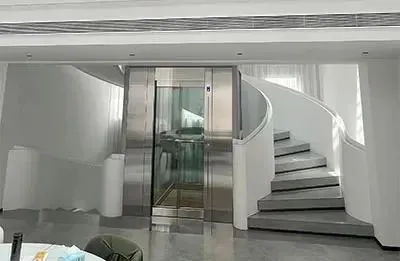
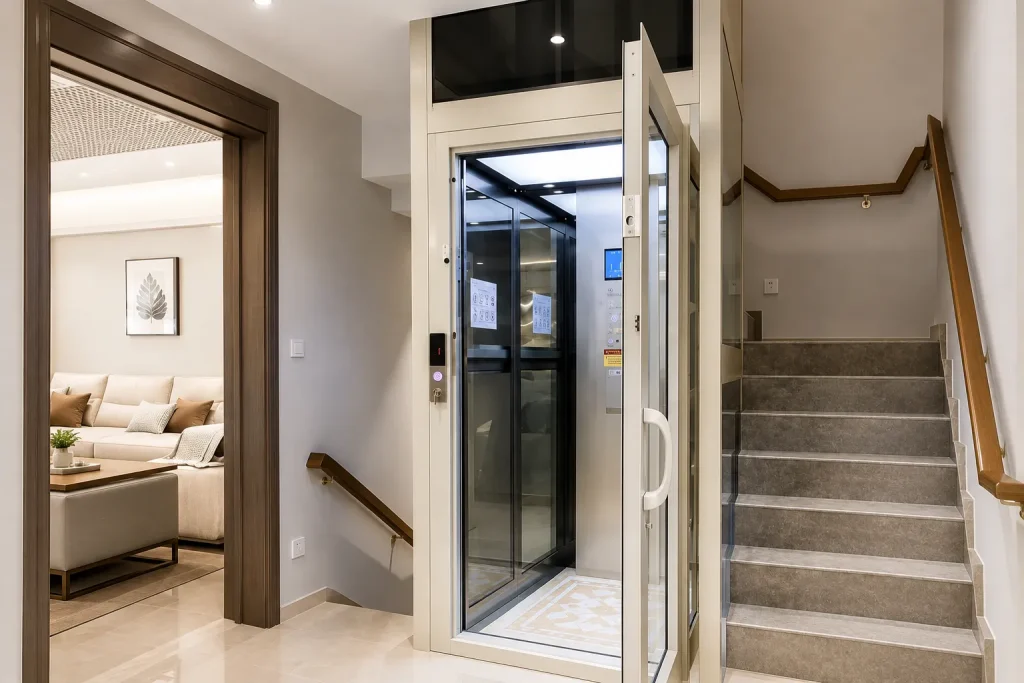
A hydraulic elevator can be installed in various locations, depending on the selected design. Possible positions may include the center of a staircase, a hallway, a floor opening, a corner, a balcony area, or a purpose-built shaft.
This flexibility makes hydraulic home elevators attractive for renovation projects where the original building did not include an elevator.
Lower Overhead Options
A hydraulic elevator does not require a traction machine directly above the elevator car. Low-overhead configurations may therefore be available when the top floor has limited vertical space.
The actual overhead requirement still depends on the car height, door arrangement, safety clearances, rated speed, and local code. Buyers should request a confirmed layout drawing instead of relying on a general minimum figure.
No Counterweight
Most hydraulic systems do not use a counterweight. Removing the counterweight can free additional space inside the elevator shaft and help increase the usable car area within a restricted opening.
This advantage is valuable in private homes, where even a small difference in the elevator shaft can affect room layout, stair access, and interior appearance.
Smooth Low-Rise Operation
A properly designed hydraulic system can deliver smooth acceleration, controlled descent, and accurate floor leveling. These qualities are important for families, elderly passengers, and users with limited mobility.
Customization Potential
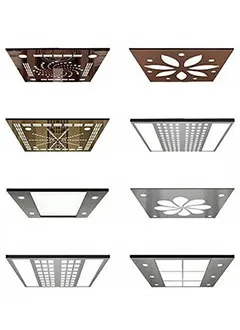
A residential hydraulic elevator can support customized cabin dimensions, glass walls, doors, flooring, ceiling panels, control boxes, lighting, colors, and decorative finishes. This allows architects and interior design studios to integrate the elevator into the home rather than treating it as separate industrial equipment.
Are Hydraulic Elevators More Energy-Efficient?
The statement that hydraulic elevators are more energy-efficient is not universally correct. Energy performance depends on the type of elevator, load, travel frequency, drive configuration, standby controls, lighting, and building height.
A hydraulic elevator consumes electricity mainly when pumping fluid to raise the elevator car. Downward travel relies more on gravity and controlled fluid return. However, a conventional hydraulic system may release potential energy as heat during descent instead of recovering it.
A modern traction elevator with a counterweight can reduce the motor effort required to move the car. Gearless traction systems and regenerative drives may also provide efficiency advantages in frequently used buildings.
For a lightly used home elevator, total energy consumption may depend more on standby power, lighting, control settings, and actual daily use than on a simple hydraulic-versus-traction label. Buyers should request comparable energy data for the proposed models.
Is a Hydraulic Elevator Suitable for a Home or Villa?
A hydraulic elevator for home is often suitable when a villa or private residence has limited overhead, requires a shallow pit, or cannot accommodate a conventional traction layout.
Typical applications include:
Private villas
Duplex apartments
Existing residential buildings
Aging-in-place home modernization
Indoor stairwells
Floor openings
Balcony installations
Low-rise residential developments
Boutique residential projects
A home elevator must do more than move passengers. It should also fit the architecture, provide convenient access, operate quietly, and complement the interior.
Jiade offers customized home and villa elevator solutions that can include panoramic glass, steel or aluminum shaft structures, decorative floors, ceiling panels, illuminated backboards, hall doors, call boxes, and other personalized options. Every final configuration should be confirmed through project drawings and technical review.
Why Work With Jiade for a Customized Home Elevator?
Jiade (Shandong) Elevator Co., Ltd. specializes in the research, development, manufacturing, and sales of high-end home elevators and villa elevators. We serve professional B2B buyers, including residential developers, elevator distributors, agents, contractors, architects, interior designers, and engineering solution providers.
Our product scope includes hydraulic, traction, and platform elevator solutions. We focus on factors that matter in long-term project cooperation:
Safety and operational stability
Drive-system reliability
Flexible dimensional customization
Glass and shaft options
Cabin and decorative customization
OEM and ODM support
Factory-direct communication
Project-based technical coordination
Long-term supply potential
For overseas projects, we recommend beginning with the building layout. Our team can then evaluate the shaft, pit, overhead, travel, capacity, entrance, and design requirements before preparing a customized proposal.
FAQ
Does a hydraulic elevator need a machine room?
Not always. A machine room-less hydraulic elevator can avoid a traditional separate machine room. However, the pump, reservoir, controller, and related components still need an accessible and approved installation location.
What is the difference between a holeless and pitless hydraulic elevator?
A holeless hydraulic elevator does not require a deep underground bore for the cylinder. A pitless elevator requires little or no conventional elevator pit. One product may support both characteristics, but the terms do not mean the same thing.
How high can a hydraulic elevator travel?
The maximum height depends on the hydraulic cylinder, piston arrangement, lifting method, rated load, number of floors, speed, and local regulations. Final travel data must be confirmed for the selected hydraulic elevator model.
Is a hydraulic elevator suitable for an existing house?
It may be suitable when the building has limited pit depth, low overhead, or no original elevator shaft. The structure must still be surveyed to confirm available space, foundation conditions, power supply, entrances, and local approval requirements.
Which is better for a villa: hydraulic or traction?
A hydraulic system may be preferable for a low-rise villa with constrained space and moderate use. A traction elevator may be better for greater travel, more frequent operation, or higher speed. The correct choice depends on the project rather than one technology being universally superior.
What information is required for a hydraulic elevator quotation?
Provide the shaft dimensions, pit depth, overhead, travel height, number of stops, rated load, door arrangement, installation location, power supply, finish preferences, and destination country. Architectural drawings are especially useful.

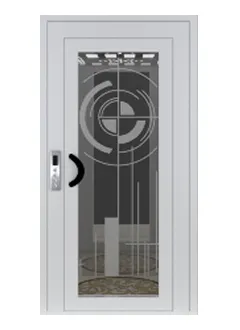
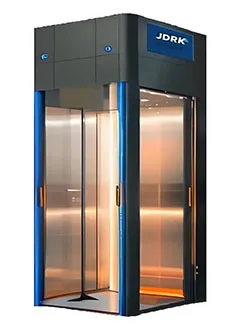
 Personnaliser la commandeType de traction Villa ElevatorAscenseur domestique à traction : Pas de salle des machines, ce qui permet de réduire les coûts. Utilise un contrepoids/un portique, s'adapte aux types de portes de la maison. Entraînement VVVF pour un déplacement en douceur
 French
 English
 German
 Russian
 Spanish
 Portuguese
 Dutch
 Arabic
 Czech
 Japanese
 Korean