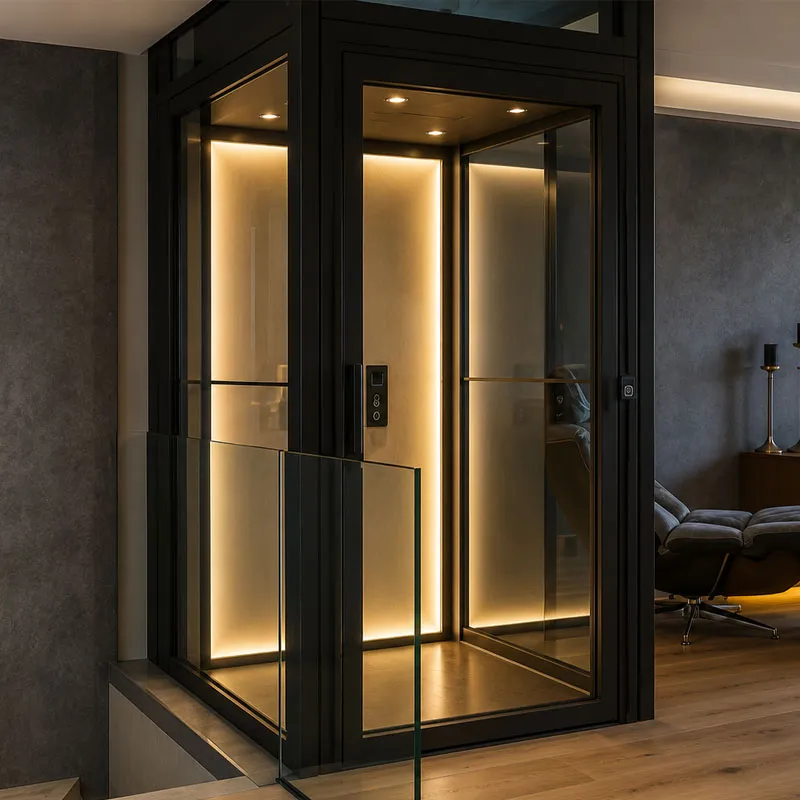
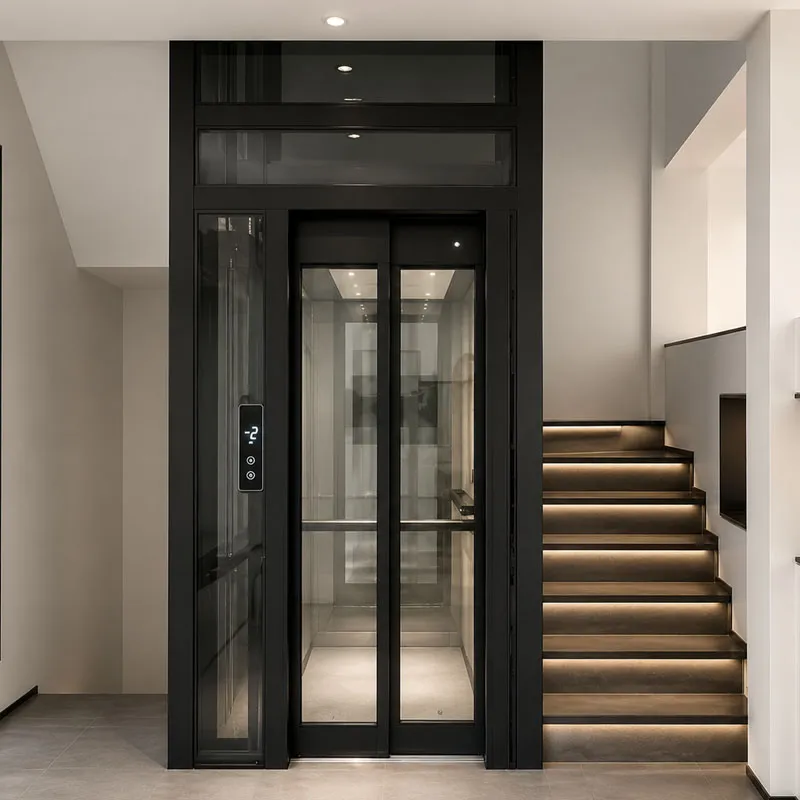
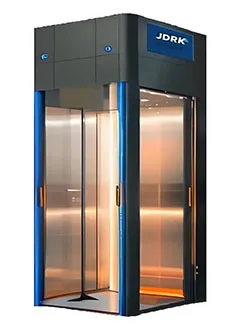
Ein hydraulisch angetriebener Wohnaufzug für eine Villa verwendet hochwertige Zylinder, Pumpen und Steuerventile. Das hochpräzise Proportionalventil sorgt für eine reibungslose, stabile und stufenlose Geschwindigkeitsregelung.
Hydraulic Elevators: How They Work & Where They Fit
Jiade (Shandong) Elevator Co., Ltd. Technical Team | JDRK Product Team Published July 2026
A hydraulischer Aufzug lifts the cabin using fluid pressure pushing a piston upward, then lowers it by releasing that pressure and letting gravity bring the cabin back down. JDRK’s Hydraulic Domestic Elevator applies this principle in a no-machine-room villa configuration with zero-pit or shallow-pit options.
What Is a Hydraulic Elevator, and How Does It Actually Move?
Strip away the branding language and a hydraulic elevator is a fairly simple machine: a pump pressurizes hydraulic fluid, that fluid pushes a piston connected to the cabin, and the cabin rises. To descend, a valve releases pressure and the cabin lowers under its own weight rather than being pulled down by a motor. There’s no counterweight system doing the work in either direction, which is the core mechanical difference from a traction elevator.
JDRK’s version drives this with an imported high-precision proportional valve, which controls fluid flow closely enough to allow stepless speed regulation rather than fixed-speed steps. In practice that means the cabin can accelerate and decelerate smoothly instead of jumping between preset speeds.
Direct-Acting vs Holeless: The Two Basic System Types
Hydraulic systems generally split into two broad categories, and this distinction matters for anyone comparing quotes across suppliers:
Direct-acting (holed) systems sink the piston into a drilled hole below the pit, which requires excavation but keeps the mechanism entirely out of the shaft’s usable footprint.
Holeless systems mount the piston(s) alongside the cabin inside the shaft itself, avoiding excavation but taking up a slice of shaft width in exchange.
Most residential retrofit projects in dense or older neighborhoods lean holeless for exactly the reason above: drilling a piston hole below an existing foundation is often impractical. That trade-off, excavation avoided in exchange for shaft space, is the kind of decision a spec sheet alone won’t explain, which is part of why this head term draws so much competing content without much project-specific guidance.
Where Generic Guides Stop Short: Machine Rooms Aren’t Universal
Broad explainer content on hydraulic mechanics tends to center on configurations built around a separate machine room housing the pump and controller, which is standard in a lot of commercial and mid-rise installations. Compared to that common configuration, a villa retrofit rarely has a spare room to dedicate to elevator equipment, and that’s the gap most general guides don’t address directly.
JDRK’s No-Machine-Room, Zero-Pit Configuration
JDRK’s Hydraulic Domestic Elevator is built specifically for that constraint. The unit installs without a separate machine room, and it’s installable in locations where the top-floor clearance exceeds roughly 2,000 mm. There’s no counterweight in the system, which pushes usable shaft space utilization up to around 70%, since none of the shaft footprint is reserved for counterweight travel.
Pit requirements come in two forms: a zero-pit configuration for sites with no floor recess available, or a shallow-pit option starting from around 150 mm where a small recess is workable. Neither eliminates the need for planning; a “no machine room” claim doesn’t mean the drive hardware disappears entirely. The proportional valve unit and pump still need a location, typically a compact enclosure near the shaft rather than a walk-in room — a detail worth confirming against the actual floor plan before assuming zero equipment footprint anywhere on site.
For a deeper breakdown of how these dimensions play out against actual shaft and pit planning across JDRK’s full catalog, the home elevator size guide covers cab, shaft, and pit dimensions side by side.
Safety Systems Built Into the Design
Five features handle the failure modes that matter most in a residential setting. The light curtain stops the door from closing on an obstruction. The overspeed governor and safety gear engage mechanically if the cabin exceeds its rated descent speed, independent of the electronic controls. The one-touch emergency dial connects a stranded passenger directly to help rather than requiring them to locate a manual or call a separate number. The ARD lowers the cabin to the nearest floor automatically during a power outage, so a mid-shaft stop during a blackout isn’t the default outcome.
None of these are unique to hydraulic systems specifically, but a system with no counterweight and no machine room puts more weight on gravity-return behavior working predictably, which is where the overspeed governor and safety gear earn their place on the spec sheet rather than being a formality.
The Honest Trade-Off: What Hydraulic Gives Up
Every “no machine room, no counterweight” configuration trades something for that footprint saving. The proportional valve setup buys smooth stepless speed control, but the drive principle itself, pressure up and gravity down, means the system’s performance characteristics differ from a motor-driven traction system in ways that matter for taller travel heights or higher-traffic use. For a side-by-side on when hydraulic makes sense versus a traction setup, the hydraulic vs traction comparison covers that decision directly rather than repeating it here.
Pricing
JDRK doesn’t list prices for the hydraulic line on its site; every product page routes to a quote request instead. Final cost depends on cab size, pit configuration, travel height, and finish, so there isn’t a general price range to quote here — request a configuration-specific quote for an actual project figure.
FAQ
Q: Does a hydraulic elevator need a pit?
A: JDRK’s version offers a zero-pit configuration for sites with no available floor recess, or a shallow-pit option starting around 150 mm where a small recess works.
Q: Is a machine room required?
A: No. The unit is built to install without a separate machine room, provided top-floor clearance exceeds roughly 2,000 mm.
Q: What happens during a power outage?
A: The built-in ARD (Automatic Rescue Device) lowers the cabin to the nearest floor automatically rather than leaving it stopped mid-shaft.
Q: How small can the cab be customized?
A: The minimum customized cab size is approximately 1,100 × 1,100 mm; confirm exact dimensions against your shaft before finalizing a layout.
For a project-specific quote or shaft assessment, JDRK’s team can be reached via WhatsApp at +86 18453808217 or +86 15053187609.

 Bestellung personalisierenTraktionsart Villa AufzugTraktions-Heimaufzug: Kein Maschinenraum, spart Kosten. Verwendet Gegengewicht/Gantry-Stil, passt zu Haustür-Typen. VVVF-Antrieb für sanfte Fahrt
 German
 English
 French
 Russian
 Spanish
 Portuguese
 Dutch
 Arabic
 Czech
 Japanese
 Korean