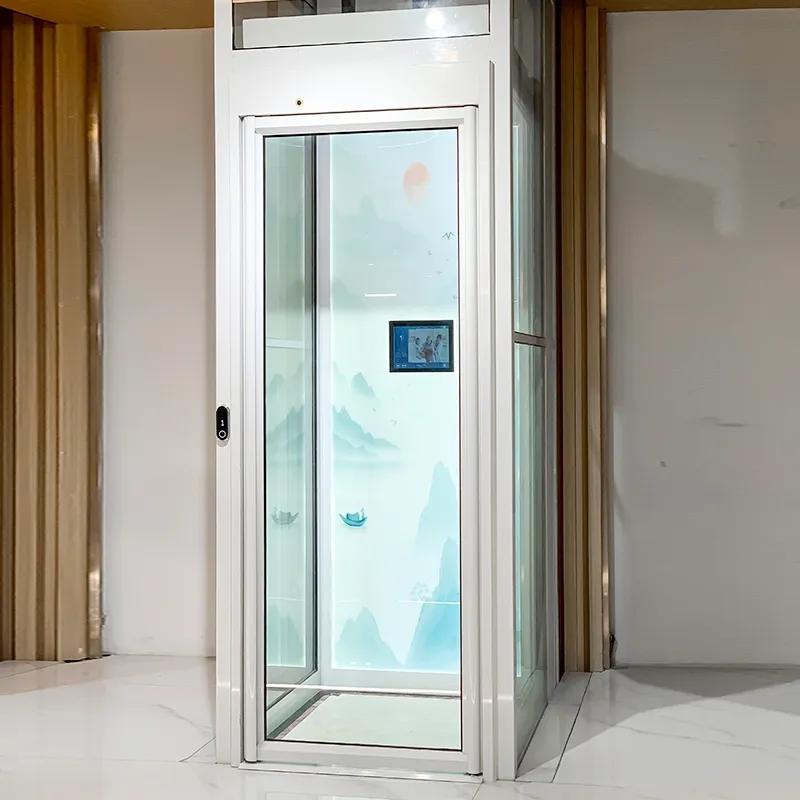
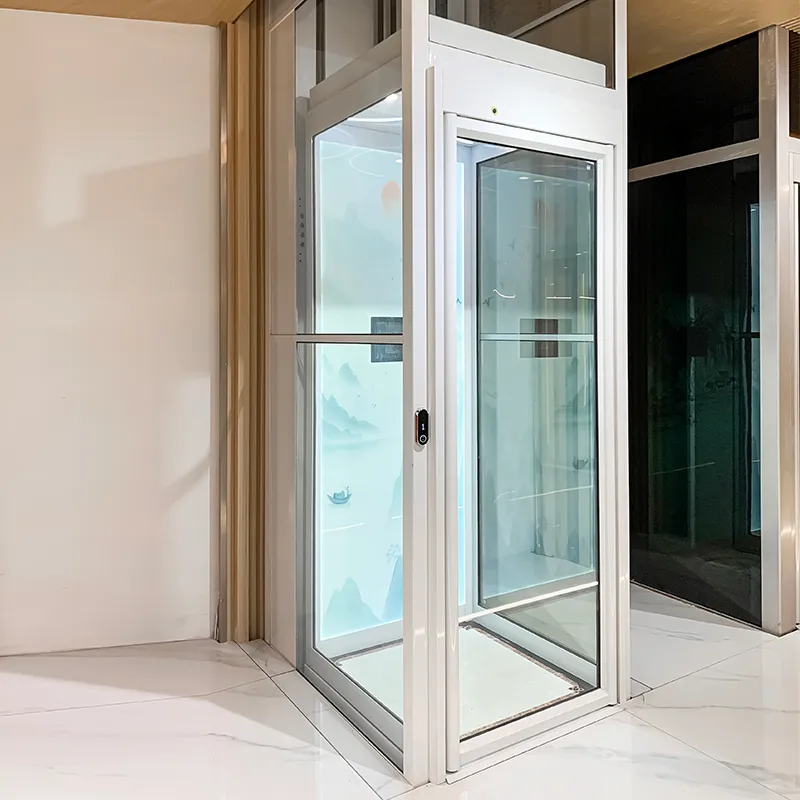
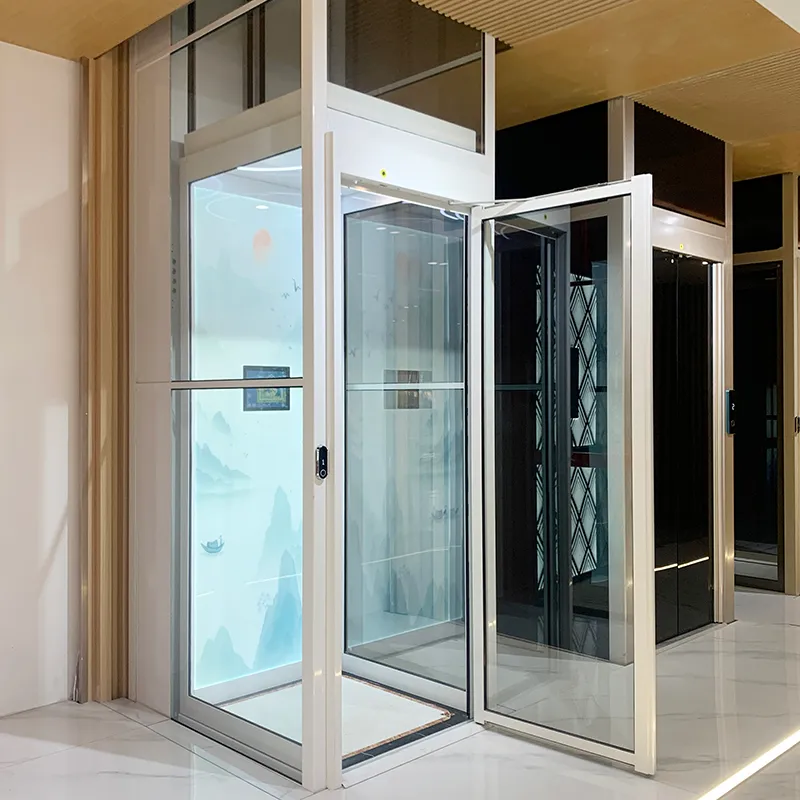
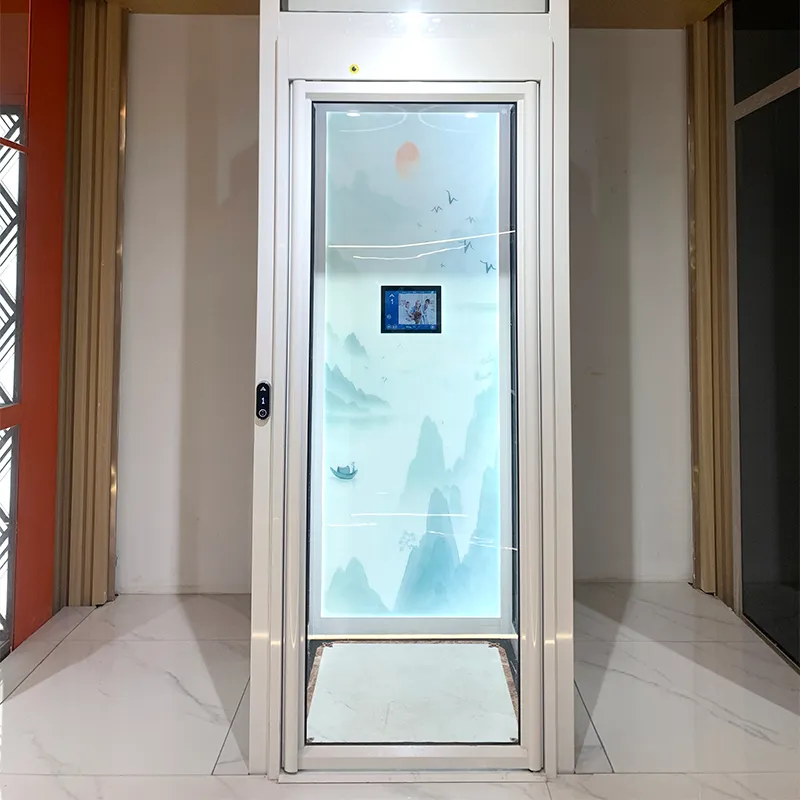
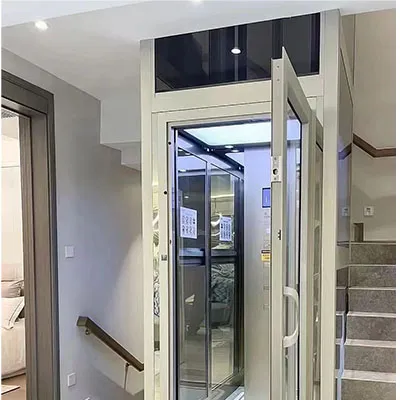
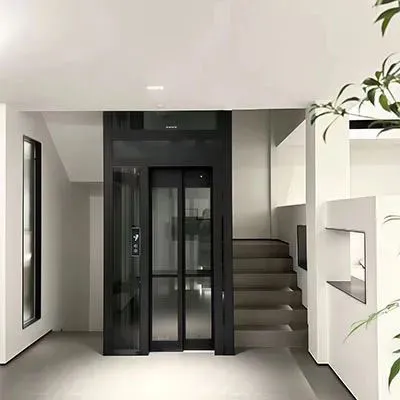
Ein hydraulisch angetriebener Wohnaufzug für eine Villa verwendet hochwertige Zylinder, Pumpen und Steuerventile. Das hochpräzise Proportionalventil sorgt für eine reibungslose, stabile und stufenlose Geschwindigkeitsregelung.
Backpack Side-Mounted Villa Elevator: A Compact Traction Home Elevator for Limited Space
Choosing a home elevator for a tight villa layout can be frustrating. A standard system may take too much shaft space, complicate installation, or disrupt the interior plan. A backpack side-mounted villa elevator solves this by moving the drive and guiding structure to one side, making compact installation much easier.
A backpack side-mounted villa elevator is a gearless traction home elevator designed for villas, duplex homes, and low-rise residential buildings with limited space. On JDRKCN’s product page, it is positioned as a compact, quieter, more energy-efficient solution that supports wall-side or corner installation and can work with dedicated steel or glass shaft structures.
When I look at what serious B2B buyers want from a residential lift project, the pattern is clear. They do not just want an elevator that moves. They want a product that fits narrow layouts, looks premium, reduces installation difficulty, and comes from a factory that can support customization, documentation, and long-term project cooperation. That is exactly where Jiade (Shandong) Elevator Co., Ltd. tries to compete as a professional manufacturer of home and villa elevators.
For overseas distributors, contractors, architects, and villa developers, this product is not simply another traction lift. It is a compact layout solution for projects where traditional shaft planning is not ideal. That makes it useful for new villas, duplex retrofits, aging-in-place homes, and premium residential upgrades.
What Is a Backpack Side-Mounted Villa Elevator?
A backpack side-mounted villa elevator is a traction-type residential elevator where the driving and guiding systems are integrated on one side of the shaft. JDRKCN describes this arrangement as a way to reduce construction-space usage and simplify installation. In plain language, the elevator keeps more of its working structure to one side rather than spreading it across a larger conventional layout.
This matters in villa projects because space is expensive. In a private residence, every square meter affects staircase design, hallway width, and visual flow. A side-mounted design helps preserve usable space while still providing a full-function home lift. That is why this type of elevator is especially relevant for villas, duplex homes, and low-rise residential buildings with structural restrictions.
From a market view, it is also easier to position. Dealers can present it as a premium compact solution, not just a generic elevator. That helps B2B buyers sell function and design at the same time.
How Does the Side-Mounted Traction Elevator Work?
The product page presents this model as a gearless traction elevator system. In practice, that means the elevator uses a traction drive rather than a hydraulic lifting method, and JDRKCN emphasizes smoother, quieter, and more energy-efficient vertical transport as a result. Its broader traction-elevator page also explains that traction systems use a traction machine, counterweight, and ropes to move the cabin.
For villa projects, that combination is important. A traction system often supports better ride comfort, daily operating stability, and more refined positioning in the premium residential market. JDRKCN also states that its traction platforms are available in machine-room and machine-room-less styles depending on building conditions, which gives designers more freedom in the early planning stage.
Why Is This Elevator a Strong Fit for Villas and Duplex Homes?
JDRKCN clearly positions this product for villa elevators, duplex homes, and low-rise residential buildings. That is not accidental. These projects often face the same design challenge: owners want an elevator, but the building was not planned around a large standard shaft. A side-mounted structure is easier to align with practical residential constraints.
The product also works well for buyers who care about both daily usability and resale value. In a premium villa, an elevator is not just vertical transport. It supports accessibility, convenience, and long-term living comfort. For older residents, multi-generation households, or luxury renovation projects, a well-integrated home elevator can become a major functional upgrade.
This is one reason developers and design studios often prefer factory-supported residential lift systems over improvised local solutions. A purpose-built product is easier to quote, explain, install, and maintain.
Is a Special Shaft Required for This Home Elevator?
Not always, but a proper shaft strategy is important. JDRKCN presents two main material directions for this product: a steel structural cross-section and an aluminum-alloy cross-section with independent frameless glass design. The steel option is described as cost-effective and rust-resistant after treatment, while the aluminum-alloy option is positioned as highly transparent, corrosion-resistant, and visually seamless indoors.
That gives project teams two clear routes. If the focus is budget control and practical structural performance, steel is often easier to justify. If the focus is visual integration and premium interior presentation, a frameless glass shaft becomes much more attractive.
What Safety Features Make This Elevator Suitable for Residential Use?
The page highlights several safety and smart-operation features. These include an ARD automatic rescuer device that brings the elevator to the nearest floor during a power failure, automatic cabin lighting that switches off when idle and on when called, IoT connectivity for identification, monitoring, and management, a built-in fixed telephone device in the control box, one-button emergency calling, and landing-door interlock checks.
For home and villa use, these features matter more than they do in basic industrial lifting equipment. A residential owner expects simple, reassuring operation. In the event of an outage or abnormal condition, the user should not need technical knowledge. The system should respond automatically and safely. That is exactly the purpose of ARD and emergency communication features.
A practical safety summary looks like this:
nearest-floor rescue during power failure
emergency call support
fixed communication device
automatic lighting logic
door interlock verification
smart monitoring potential through IoT connectivity
For B2B buyers, these are not just product details. They are sales points that help build trust with developers, homeowners, and local installation partners.
How Does It Support Customization for Premium Home Projects?
JDRKCN makes a strong effort to present this as a customizable home elevator rather than a fixed-spec commodity product. The page mentions custom push-button call boxes with touch, mechanical, and digital styles. It also highlights decorative floor series such as marble, medallion, and ink-style patterns.
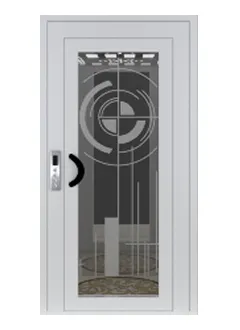
That matters because in the villa market, appearance is often part of the buying decision. Door finishes, control panels, floor design, shaft transparency, and lighting all affect whether the elevator feels “basic” or “premium.” JDRKCN’s separate push-button and elevator-door pages also reinforce that the company supports multiple control-panel styles and multiple door-opening configurations for different layouts.
When I look at how distributors build stronger product portfolios, customization is usually one of the biggest reasons they stay with a factory long term. It helps them target different price levels and architectural tastes without switching suppliers.
What Should Buyers Confirm Before Ordering?
JDRKCN advises project teams to confirm travel height, shaft size, available roof space, and power-supply conditions early in the design stage for traction systems. That guidance is especially useful for this side-mounted model because its biggest value comes from matching the product correctly to the building layout.
I would reduce that into a simple project checklist:
Pre-Order Checklist
Confirm the building type: villa, duplex, retrofit, or low-rise residential.
Measure available shaft or installation space.
Check whether wall-side or corner installation is preferred.
Confirm pit depth and top-floor height.
Decide on steel shaft or glass shaft direction.
Review control panel, door, and decorative options.
Clarify power supply and local code expectations.
Ask for drawings and recommended layout support.
This kind of early-stage discipline saves time later. It also helps buyers compare quotations based on real engineering needs, not vague assumptions.
How Does This Product Support Long-Term Project Cooperation?
JDRKCN has 10,000+ satisfied customers worldwide, 10+ international certifications, 10,000+ successful installations, and end-to-end support for luxury villas, aging-in-place homes, and smart residences. While these are brand claims from the company’s own site, they still show how JDRKCN wants to be perceived in the market: as a long-term manufacturing partner rather than a one-off supplier.
For overseas distributors and contractors, that positioning is important. A serious residential elevator project involves drawings, configuration, customization, installation coordination, documentation, and after-sales planning. A factory that presents a full product system, related accessories, and structure options is usually easier to work with than a company selling only a cabin or drive unit.
That is why this product page works well not only as a product description, but also as a B2B trust page. It gives buyers a reason to continue the conversation.
Is the Backpack Side-Mounted Villa Elevator the Right Choice for Your Project?
If your project involves limited installation space, a wall-side or corner layout, or the need for a more elegant residential lift design, this product is a strong option. Its core strength is not just traction technology. Its real strength is how that technology is packaged into a compact, side-mounted, customization-friendly solution for villas and duplex homes.
For premium residential buyers, that creates a compelling balance of function and design. For distributors and contractors, it creates a more marketable product line. And for architects, it provides another way to solve space restrictions without giving up visual quality.
It is a residential traction elevator where the driving and guiding systems are integrated on one side of the shaft. JDRKCN positions it as a compact, space-saving solution for villas, duplex homes, and low-rise residential buildings.
Is this product machine-room-less?
The product page describes it in a no-machine-room style context, and JDRKCN’s traction platforms also include machine-room-less options depending on the project layout. Final configuration should be confirmed with the factory for each project.
Can it be installed in an existing home?
Yes. The page shows several building-structure options, including existing elevator wells, staircase middle spaces, hollow halls or rooms, and indoor retrofits created by opening floor holes and adding a shaft.
What safety features does it include?
The page highlights ARD nearest-floor rescue, emergency one-button call, a fixed telephone device, automatic lighting logic, IoT connectivity, and landing-door interlock checks.
Can the appearance be customized?
Yes. JDRKCN mentions custom call-box styles, decorative floor choices, and shaft-material options including steel structures and frameless glass aluminum-alloy structures.

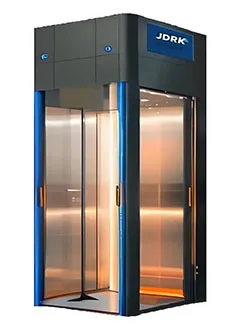
 Bestellung personalisierenTraktionsart Villa AufzugTraktions-Heimaufzug: Kein Maschinenraum, spart Kosten. Verwendet Gegengewicht/Gantry-Stil, passt zu Haustür-Typen. VVVF-Antrieb für sanfte Fahrt
 German
 English
 French
 Russian
 Spanish
 Portuguese
 Dutch
 Arabic
 Czech
 Japanese
 Korean