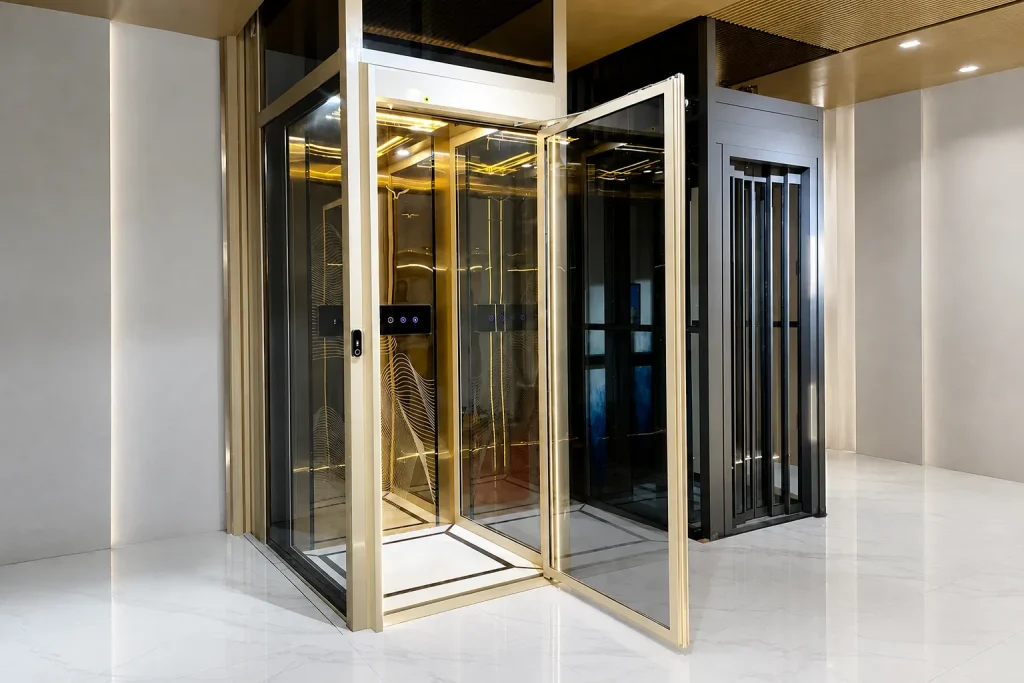
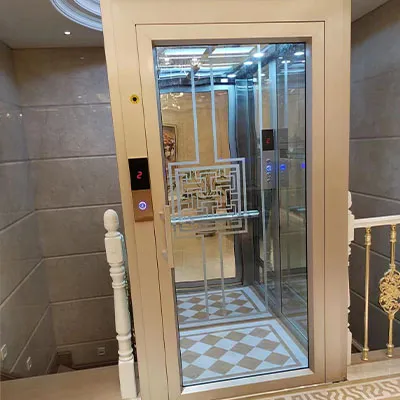
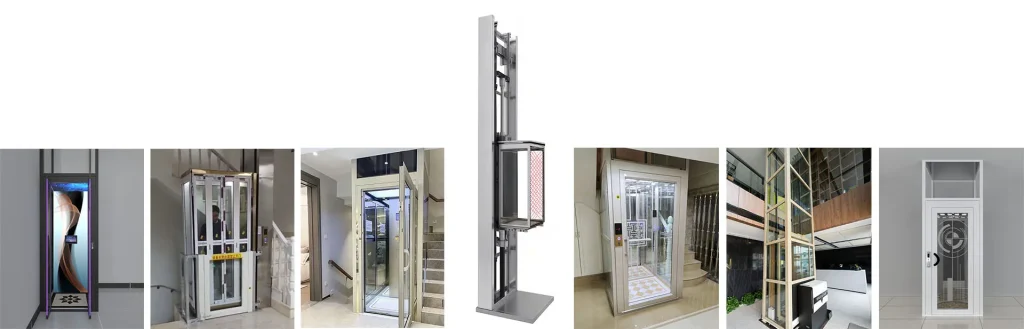
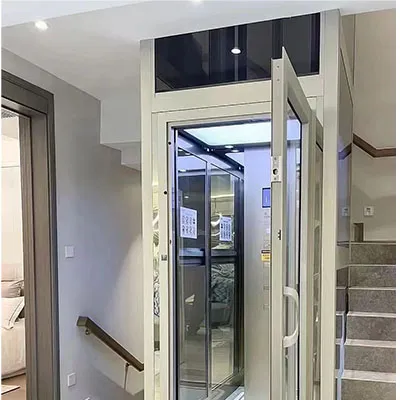
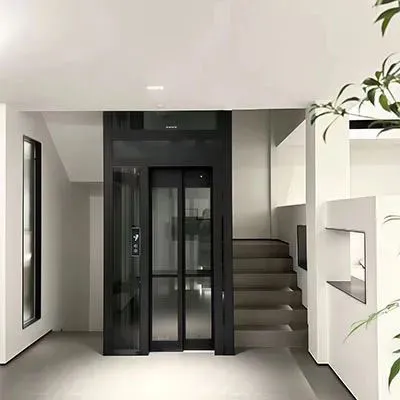
Hydraulicky poháněný obytný výtah pro vily využívá špičkové válce, čerpadla a ovládací ventily. Jeho vysoce přesný proporcionální ventil by měl mít plynulou stabilní plynulou regulaci rychlosti.
Hydraulic Elevator Advantages (and the Trade-Offs)
A hydraulic home elevator rises under hydraulic pressure and descends by gravity, which removes the machine room and the counterweight. The gains are real, but each has a limit: 2600 mm minimum top-level height, 150 mm minimum pit depth. Here are six advantages, with their trade-offs.
Six advantages, each with its catch
1. No machine room, but you still need headroom
JDRK’s Hydraulic Domestic Elevator needs no separate machine room, so no floor area is given up to equipment. The catch is vertical: the product can be installed where top-floor clearance exceeds roughly 2 m, and the minimum top-level height is 2600 mm. Those are two different figures in JDRK’s material. Ask which one applies to your shaft before you draw anything.
Note also that JDRK’s traction villa model is machine-room-less too. This advantage does not separate the hydraulic type from the traction type within the same range.
2. No counterweight, so the shaft is used more fully
Compared with counterweighted lifts, a common design for home traction models, JDRK’s hydraulic model drops the counterweight. The company says shaft space utilization reaches up to about 70%. That number is self-reported and has no independent test behind it, so check it against your own shaft drawing. The minimum customized size is about 1100 × 1100 mm; whether your shaft can take a cabin that small or larger is a drawing question, not a brochure one.
3. Zero-pit or shallow-pit options
For houses where digging is hard, zero-pit and shallow-pit versions are offered. The published minimum pit depth is 150 mm. Zero-pit is an option, not the default, and JDRK does not publish what it changes elsewhere, such as clearance at the top. Ask for that in the quote.
4. Stepless speed regulation
An imported high-precision proportional valve regulates speed continuously rather than in fixed steps. That is the stated mechanism. No rated speed, noise level or valve brand and model is published, so “quiet” and “smooth” are things to test or ask about, not things this spec sheet proves.
5. A listed safety package
The model lists a light curtain, overspeed governor, safety gear, one-touch emergency dial, and ARD (Automatic Rescue Device). The gap: no rescue distance, battery duration or response time for the ARD is published, and company-wide certification marks come without certificate numbers.
6. Suited to narrow shafts and retrofits
JDRK positions the no-machine-room, no-counterweight, shallow-pit layout around retrofits in narrow shafts and existing buildings. Before you commit, note that rated load, rated speed, number of stops and maximum travel height are not published for this model.
Rated load, speed, power requirement, maximum travel height, noise level
Where buyers misread the brochure
“Machine-room-less” is read as “needs no extra height.” It is not: the 2600 mm top-level figure is a hard minimum, so measure from the finished floor of the top landing to the underside of the ceiling or roof structure.
“Zero-pit” gets read as “no excavation, guaranteed.” It is an option that depends on the project. Run this check before asking for a quote:
Measure the shaft width and depth in millimetres.
Measure the height above the top landing.
Find out whether your slab allows a 150 mm pit.
Ask whether zero-pit is feasible for your shaft and what it changes.
Ask for the missing figures: load, speed, power, maximum travel.
FAQ
What does a hydraulic home elevator cost?
JDRK publishes no prices. Every product page routes to a quote form, so a quote based on your shaft, pit and cabin finish is the only reliable answer.
Which cylinder does it use?
Cylinder type, stroke and layout are not in JDRK’s published material. Ask for them with your quote.
What power does it need?
Not published for the hydraulic model. JDRK’s traction villa model is built for 220V single-phase household power, so confirm separately which applies to the hydraulic model.
Is it right for a very tall house?
Maximum travel height is not published. If your building has more than a few floors, ask for it before comparing against traction.

 Přizpůsobit objednávkuTrakční typ výtahuTrakční domácí výtah: Žádná strojovna, úspora nákladů. Používá protizávaží/gantry styl, hodí se k typům domovních dveří. Pohon VVVF pro hladkou jízdu
 Czech
 English
 French
 German
 Russian
 Spanish
 Portuguese
 Dutch
 Arabic
 Japanese
 Korean